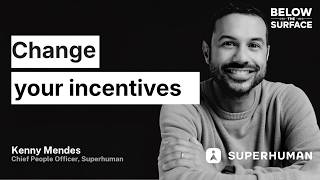
In this interview, Superhuman Chief People Officer Kenny Mendes discusses rebuilding corporate culture and identity following the acquisition of Coda by Grammarly and the subsequent rebranding to Superhuman. Mendes shares frameworks for shifting employees from fish to pond thinking, details the mechanics of voluntary equity swap programs, outlines the optional return to office model, and explains why he centralized compensation decisions away from managers.
Kenny Mendes is the Chief People Officer at Superhuman, an AI-powered email productivity platform. Previously, he was the first recruiting hire at Box, scaling the company from forty to over twelve hundred employees, and later served as an early executive at Coda, helping lead it through its acquisition by Grammarly. Following Grammarly's rebranding to Superhuman, Mendes leads talent, culture, and organizational strategy, specializing in incentive structures, remote work design, and performance management.
August 20, 2026
In a massive pond like Google, one fish cannot dramatically change the size of the pond. As a result, employees develop fish thinking, focusing on their specific role, title, levels, and reporting lines. In a tiny pond like a startup, employees focus on pond thinking, dedicating themselves entirely to expanding the pond rather than worrying about their personal titles.
Large organizations build processes and frameworks geared towards maintaining scale. These frameworks often encourage employees to compare themselves to their peers. Small organizations need to remain nimble and prioritize innovation. Even at a larger scale, we had to adjust our processes to motivate employees to act like they were in a small pond.
When your largest compensation increases only happen through promotions, employees focus all of their energy on getting promoted rather than doing high-impact work. This leads to employee departures when career paths are blocked. It also leads to empire-building, where managers hire unnecessary personnel just to justify managing managers for a higher title.
We reduced the pressure to get promoted to grow compensation. Instead of forcing employees to seek promotions, we calibrated talent and tapped high performers on the shoulder to award salary refreshes directly. This allows key individual contributors to earn more money than their managers without forcing them to transition into people management roles.
We observed that employees had compensation plans skewed heavily toward cash salary and very little toward equity, which made them feel disconnected from the company's success. We designed a voluntary program allowing employees to trade guaranteed cash salary for equity holdings, giving them meaningful ownership to align their daily work with company growth.
Conventional wisdom suggests that European employees only care about cash and are uninterested in equity. We discovered that they were simply uneducated on how equity works and its tax implications. Once we provided clear enablement and tax support, our European offices achieved some of our highest participation rates.
More than half of our sales team participated in the program, defying the stereotype that sales professionals only value cash commissions. This high participation could be attributed to the sales team's visibility into our product roadmap, or simply their natural tolerance for taking risks to secure larger financial outcomes.
It completely changed the daily office conversation. Instead of employees asking about titles or promotion timelines, everyone focused on the value of their equity. Product leaders reported coming to work on Monday feeling like true owners, driving their engineering teams to ship features faster because they were personally invested in the outcome.
We give new hires three distinct choices when extending an offer: high cash with low equity, medium cash with medium equity, or low cash with high equity. This trains employees right from the start to think critically about their ownership and understand that equity is not just a lottery ticket but a core component of their wealth.
Instead of sitting on the sidelines as a coaching and processing function, we put our team directly in the field. When high performers announce their intent to leave, we do not just process their termination. We sit down with them to understand their frustrations, allowing us to resolve issues and retain them.
Grammarly had rolled out a mandatory two-day in-office requirement for engineering, product, and design. Employees hated it because they felt forced. Even on mandatory days, the offices felt empty because people were simply not complying. It was the worst-case outcome because it created resentment without achieving the desired collaboration.
Mandates are a way of saying you do not trust employees to do the right thing unless you can physically watch them. If you treat employees like children, they will act in untrustworthy ways. If you tell them you trust them and treat them like adults, they will behave like adults and make responsible decisions.
We scrapped the mandate and acknowledged our distributed reality. We sat down with employees to listen to their friction points, like brutal commutes and meal planning. We then allowed everyone to opt into a two, three, four, or five-day plan. Each plan came with incentives, such as dedicated desks and wellness stipends.
We offered a quarterly wellness stipend, increasing the amount for those opting into the five-day plan. While the financial amount is small compared to salary, it was meaningful enough to offset the friction of coming to the office. It allowed employees to buy an e-bike, take an Uber, or order food delivery guilt-free.
Proximity matters for team building. Studies show that if you sit thirty feet away from a coworker, you might as well be in another zip code. We took off the five-foot desk tops and replaced them with four-foot tops to pack everyone closer together. This instant proximity built trust and boosted office energy.
In typical systems, the highest-paid person in the calibration room decides who gets paid what, which limits compensation growth for individual contributors. By removing managers from setting compensation, we centralized decisions within the people team. This allows us to deliver compensation messages with higher retentive value and prevent empire-building.
Interviewing is a highly flawed process that produces many false positives and negatives. Interview scorecards often over-rotate on brief interactions. Reference checks are far more valuable because they provide rich signals from individuals who have worked with the candidate for years and can objectively vouch for their capabilities.

Use this interview in your research, article, or academic work

Co-founder & CEO at Cluely
In this interview, Cluely co-founder and CEO Chungin Roy Lee discusses the gold rushes inside AI, focusing on AI video production and capturing arbitrage from…

Co-founder & CEO at Happy Robot
In this interview, Happy Robot co-founder and CEO Pablo Palafox explains how AI agents are moving beyond answering questions to executing complex coordination tasks across…

Co-founder & CEO at World Labs
In this interview, World Labs co-founder and CEO Fei-Fei Li discusses spatial intelligence, world models, and the future of computer vision. Li explains the distinction…

Co-founder & CEO at CodeRabbit
In this interview, CodeRabbit co-founder and CEO Harjot Gill discusses the evolution of AI-powered code reviews and automated validation tools. Gill shares insights from his…

Founder, Chairman & CEO at C3 AI
In this interview, C3 AI founder, chairman, and CEO Tom Siebel discusses the historical evolution of enterprise artificial intelligence and the role of education in…

Co-founders (CEO & President) at Anthropic
In this interview, Anthropic co-founders Dario and Daniela Amodei address the safety and ethical dilemmas of rapid artificial intelligence development. The siblings discuss the capabilities…