
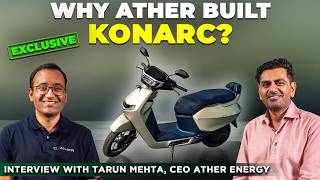
In this interview, Ather Energy co-founder and CEO Tarun Mehta discusses the evolution of India's electric two-wheeler market and the unveiling of the EL platform scooter, the Konaq. Mehta explains the engineering rationale behind introducing a comfortable, metal-bodied family scooter to convert traditional internal combustion engine buyers, details manufacturing capacity expansions across Hosur and Aurangabad, and shares insights on market expansion, export opportunities, and potential electric motorcycle developments.
Tarun Mehta is the co-founder and CEO of Ather Energy, a pioneering Indian electric vehicle manufacturer founded in 2013. An alumnus of IIT Madras, Mehta spearheaded the development of India's first intelligent electric scooters, the Ather 450 series and the family-focused Rizta. Under his leadership, Ather Energy has built extensive fast-charging public infrastructure, proprietary software architectures, and advanced manufacturing facilities across Tamil Nadu and Maharashtra.
September 03, 2026
The technology curve for traditional internal combustion engines had plateaued after decades of maturity. The electric transition has injected tremendous dynamism into automotive engineering across battery technology, fast-charging networks, power electronics, and software-defined vehicle architectures. This technological transformation allows engineering teams to continuously innovate and release meaningful vehicle upgrades every single year.
As the Indian scooter market premiumizes, customer preferences fragment across diverse use cases rather than accepting a one-size-fits-all product. While the 450 platform delivered exceptional agility for urban commuting and Rizta solved core family space needs, we recognized a distinct demand for superior long-distance comfort, plush suspension, center stands, and traditional handle-mounted lighting, which led directly to designing the flexible EL platform.
The 450 platform is engineered to keep riders dynamically connected to the road for twenty-to-thirty-kilometer commutes, whereas the Konaq is designed to isolate the rider from road imperfections over longer forty-to-fifty-kilometer journeys. Featuring fourteen-inch wheels, an extended wheelbase, long rear suspension travel, and a commanding road presence, the Konaq delivers an exceptionally smooth and effortless cruising experience.
While lightweight composites remain technically superior from a pure engineering standpoint, traditional petrol scooter buyers perceive metal body panels as the ultimate benchmark of durability, solid construction, and familiarity. Because the primary strategic goal of the Konaq is to convince traditional internal combustion engine owners to switch to electric, we embraced metal body styling to eliminate consumer hesitation.
We reviewed approximately two hundred potential product names over an intensive month-long evaluation process involving company-wide testing. The name Konaq emerged because it captures the vehicle's solid, enduring presence, timeless styling, and strong Indian resonance, with the final sound subtly evoking the imagery of an electric power arc.
Recent geopolitical conflicts and fuel supply volatility highlighted the strategic limitations of fossil fuel reserves, making consumers realize that electricity is a significantly more dependable domestic commodity. Coupled with expanding residential solar adoption, electric two-wheelers have evolved from a cautious secondary vehicle into the primary, economically secure household transportation choice.
With customer waiting periods stretching to several months in key regional markets, we have optimized our Hosur manufacturing facility to operate exclusively for core vehicle assembly by relocating component warehousing and storage offsite. This process efficiency has expanded plant capacity toward forty-two thousand units monthly while pausing aggressive retail showroom expansion until vehicle supply balances demand.
The greenfield facility in Maharashtra will go live by the end of this calendar year, with manufacturing scale-up ramping through early next year. The factory will primarily produce EL platform products like the Konaq, while Hosur focuses on the 450 platform and Rizta. Due to robust demand projections, we are already fast-tracking Phase Two expansion of the new plant.
The capital raised through preferential issues and qualified institutional placements will accelerate manufacturing expansion and fund new product platform development. As consumer demand multiplies across diverse demographics, maintaining market leadership requires a wider vehicle portfolio that addresses multiple price tiers and distinct functional use cases.
With thirty to forty percent of scooter buyers actively adopting electric powertrains, a substantial spillover effect into the motorcycle segment is inevitable. An electric motorcycle must prioritize superior ride dynamics, handling, and agility over impractical five-hundred-kilometer battery ranges, and we are actively advancing engineering work on our proprietary motorcycle platform.
Early-stage growth companies must remain intensely disciplined to avoid operational distraction and failure. Ather remains strictly focused on scaling its core electric two-wheeler business, fast-charging public infrastructure, and proprietary embedded software rather than diluting resources by launching passenger cars or operating capital-heavy physical resale dealerships.
Our international expansion in neighboring markets like Nepal and Sri Lanka has demonstrated exceptional early momentum, with Sri Lanka already operating dozens of retail touchpoints under strong consumer demand. While Southeast Asia and Latin America represent substantial future growth opportunities, domestic Indian demand will remain our primary strategic priority over the next few years.
Ather succeeds by designing products that our internal engineering and leadership teams would personally use daily. Entering international markets requires assembling dedicated regional teams who genuinely understand unique local road environments and cultural commuting habits rather than simply shipping standard shipping containers overseas.
Used vehicle valuation has historically been highly opaque and arbitrary. Ather is introducing digital resale price predictors and certified vehicle health certificates that analyze comprehensive battery performance data and ride telemetry, establishing objective, transparent benchmarks for secondary market valuations.

Use this interview in your research, article, or academic work

President & CEO at Sasol
In this interview, Sasol president and CEO Simon Baloyi discusses the operational turnaround of the global integrated chemicals and energy company. Baloyi details cross-functional collaboration…

Founder & CEO at Rocket Lab
In this interview, Rocket Lab founder and CEO Sir Peter Beck discusses the company's evolution from a rocket launch startup into an integrated space systems…

Chairman & CEO at Bentley Motors
In this interview, Bentley Motors Chairman and CEO Dr. Frank-Steffen Walliser discusses the engineering, craftsmanship, and design philosophy behind high-performance luxury cars. Walliser explains why…

Co-founder & Board Chair at Spin Master
In this interview, Spin Master co-founder Ronnen Harary discusses building a global toy empire, the power of entrepreneurship, and overcoming learning disabilities. Harary shares the…

CEO at American Pacific Mining Corp.
Warwick Smith is the CEO of American Pacific Mining, a U.S.-focused copper and gold exploration company. With over 25 years in the mining industry, he…

Co-Founder at Y Combinator
In this interview, Y Combinator co-founder Paul Graham reflects on twenty-one years of startup acceleration and forty-seven YC batches. Graham explores the nature of founder…