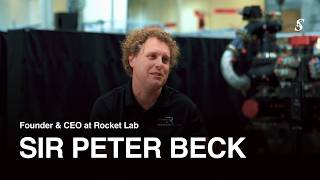
In this interview, Rocket Lab founder and CEO Sir Peter Beck discusses the company's evolution from a rocket launch startup into an integrated space systems ecosystem. Beck shares details about their strategic acquisitions, explains the moats of launch capabilities and spacecraft components, and outlines the design choices behind the Neutron vehicle. He also discusses national security contracts, the Space Force, and the future of space exploration.
Sir Peter Beck is the founder and CEO of Rocket Lab, a leading aerospace manufacturer and launch service provider. Beck founded Rocket Lab in 2006, establishing the world's first private orbital launch site in New Zealand. Under his leadership, the company developed the Electron orbital launch vehicle and is currently developing the Neutron medium-lift rocket. He has successfully integrated multiple strategic acquisitions, scaling the company into a comprehensive space infrastructure business.
August 28, 2026
This is interview 2 of 2 with Peter Beck.
Peter Beck has been featured on CEO Insider 2 times. Explore the full collection.
We realized that space systems and components represent a huge bottleneck in the industry. When we wanted to buy reaction wheels for our satellites, suppliers quoted us nine-month lead times. We decided to acquire those component suppliers directly, allowing us to build complete satellite platforms for our own missions and external customers.
We called Sinclair Interplanetary to purchase reaction wheels and were told the lead time would be nine months. Since we did not have nine months to wait, we decided to buy the company outright. Today, we have scaled that business to produce over two thousand reaction wheels annually, drastically shortening our development timelines.
Our launch capabilities represent our largest moat. Launching rockets is incredibly difficult to replicate. The second biggest moat is the manufacturing of critical spacecraft components. Even if a competitor has infinite capital, they cannot easily scale the production of specialized items like star trackers and reaction wheels.
We hired our COO, Frank Klein, from Mercedes to bring automotive manufacturing expertise to our production lines. Because we already designed and manufactured every engine, avionics box, and software suite for the Electron rocket, Frank was able to implement ERP and MRP systems that allow us to scale component production seamlessly.
Safety-critical and defense-critical communications represent the largest market opportunity in space outside of broadband. Acquiring Iridium adds immediate profitability to our P&L and secures crucial safety-critical communications spectrum. This transaction gives us the necessary runway to build and launch a new satellite constellation.
We are extremely picky and only acquire companies whose components we have already tested and integrated into our own systems. This ensures we understand their teams and know they share our uncompromising commitment to mission success. We do not buy unproven startups; our targets must have a flawless history of performance.
We used to take a light-touch approach, but we now use a well-oiled playbook. From day one of the integration, we rebrand the facilities, install Rocket Lab snack machines, distribute company apparel, and accelerate production. Our goal is to make the newly acquired team feel immediately proud of being part of Rocket Lab.
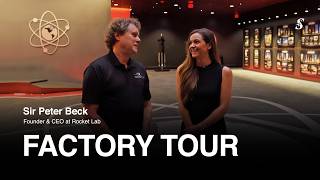
Our footprint starts with our launch pads and manufacturing facilities in New Zealand, alongside a business development team in Australia. In the United States, we have facilities in California, solar plant manufacturing in Albuquerque, optical systems in Tucson, component production in Maryland, engine testing in Mississippi, and launch pads in Virginia. We also have an optical terminal business in Germany.
We needed our own launch site to ensure our launch fees remained financially viable for our low-cost Electron rocket. Because New Zealand had no existing space industry, we built the entire supply chain and regulatory framework from scratch. The government worked with us to formulate space laws that suited our commercial needs.
Our launch site allows us to launch both sun-synchronous and mid-inclination orbits from a single location, which typically requires separate east and west coast launch sites in the United States. New Zealand also has virtually no air traffic, meaning we only have to coordinate around one plane every three days.
The Space Force gave us a twenty-four hour notice to integrate a payload satellite, roll the rocket to the pad, and launch. We completed the entire process in sixteen hours and forty-two minutes. Having complete control over our launch site and manufacturing allowed us to execute this rapid mission without airspace delays.
Public markets provide a scale of capital that is unavailable in private markets. We could not have financed large acquisitions like Iridium as a private entity. Furthermore, going public enforces the financial discipline and profitability required to build a multi-generational space company that outlives my personal tenure.
You should only go public if you need the specific resources that public markets provide. Going public is a massive amount of work and introduces constraints that make running a company less fun. Do not use public markets as a desperation move to raise capital because you cannot raise it privately.
Developing a new orbital rocket is always a complex engineering challenge, and rocket programs are prone to scheduling optimism. However, we are being highly strategic about Neutron. We want to ensure that by the time we launch the first rocket, our production lines and reuse infrastructure are fully prepared to scale rapidly.
Rocket design is a massive compromise. If you build heavy rocket structures, you must engineer high-performance engines. Conversely, if you build lightweight composite structures, you can use lower-stress engines. Because we have extensive experience with carbon composites, we chose to build lightweight structures and a low-stress engine.
I challenged our engineers to design a vehicle that could launch, return, and fly again within twenty-four hours. This constraint forced us to design the "hungry hippo" fairing, which keeps the nose cone attached to the rocket so we never throw it away or have to recover it from corrosive ocean water.
When we bid on defense contracts, we win even if we lose. If another prime contractor wins, they buy their solar panels and reaction wheels from us. When we win our own prime contracts, we win twice because we build the spacecraft and launch it using our own systems, capturing the revenue from both segments.
Use this interview in your research, article, or academic work

President & CEO at Sasol
In this interview, Sasol president and CEO Simon Baloyi discusses the operational turnaround of the global integrated chemicals and energy company. Baloyi details cross-functional collaboration…

Co-Founder & CEO at Ather Energy
In this interview, Ather Energy co-founder and CEO Tarun Mehta discusses the evolution of India's electric two-wheeler market and the unveiling of the EL platform…

Chairman & CEO at Bentley Motors
In this interview, Bentley Motors Chairman and CEO Dr. Frank-Steffen Walliser discusses the engineering, craftsmanship, and design philosophy behind high-performance luxury cars. Walliser explains why…

Co-founder & Board Chair at Spin Master
In this interview, Spin Master co-founder Ronnen Harary discusses building a global toy empire, the power of entrepreneurship, and overcoming learning disabilities. Harary shares the…
CEO at American Pacific Mining Corp.
Warwick Smith is the CEO of American Pacific Mining, a U.S.-focused copper and gold exploration company. With over 25 years in the mining industry, he…

Co-Founder at Y Combinator
In this interview, Y Combinator co-founder Paul Graham reflects on twenty-one years of startup acceleration and forty-seven YC batches. Graham explores the nature of founder…