
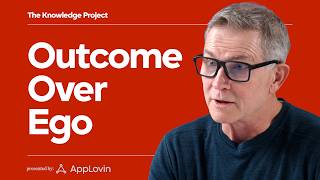
In this interview, Roblox co-founder and CEO David Baszucki discusses the platform's evolution into a major digital human co-experience platform. Baszucki outlines the value of dismantling corporate bureaucracy, details his son's recovery from bipolar disorder through ketogenic metabolic therapy, and explains product design philosophies around simplicity. He also shares insights on generalizable APIs, virtual currency economics, digital identity, safety policy, and decision-making mental models.
David Baszucki is the co-founder and CEO of Roblox, the massive digital human co-experience platform founded in 2004. A pioneer in user-generated content, he previously co-founded Knowledge Revolution, an educational physics software company. Baszucki is a dedicated advocate for mental health and metabolic psychiatry, driving research through the Baszucki Group, while leading Roblox's growth into a platform with over seventy million daily active users.
August 19, 2026
This is interview 2 of 2 with David Baszucki.
David Baszucki has been featured on CEO Insider 2 times. Explore the full collection.
My son developed severe bipolar disorder about eight to ten years ago, and we spent years trying every medication and doctor to no avail. A contact in the metabolic health community suggested a ketogenic diet, which we tried under medical supervision. Within three weeks, my son began feeling like himself again, leading to his full recovery.
I used to think of mental health issues as people just going crazy. Now, I see them as physical ailments, no different from a broken arm. Bipolar disorder is a physical brain energy issue. This experience inspired our family foundation to spend the last several years funding research into metabolic psychiatry.
The theory suggests that human bodies developed eating foods available before the agricultural revolution. While agriculture allowed our population to flourish, some individuals are not fully adapted to processing large amounts of carbohydrates. A ketogenic diet provides the brain with ketones as an alternative energy source, stabilizing metabolic and neurological function.
A high-carb diet can lead to a sluggish, hibernating state. I prioritize making decisions in a fasted, alert metabolic state where I feel optimistic and driven. Optimism expands your horizons and makes difficult choices seem possible. I observe my own state from the outside in to ensure my decision-making machinery is optimal.
I believe in simplicity and high quality. It is very easy to add knobs, sliders, and dedicated appliances, but it is extremely difficult to remove complexity. When designing products, I prefer generalizable tools of higher quality, like a beautiful knife and frying pan, over single-use appliances designed for a single task.
We actively use the term destroy bureaucracy. If an organization is not actively reducing bureaucracy, it is not staying neutral; it is going backwards. Bureaucracy is the natural entropy of a growing company, and leadership must act as a constant counterforce to streamline operations and keep things simple.
I prefer giving immediate, relaxed feedback in the moment rather than scheduling formal feedback sessions. The key is to deliver feedback in a neutral, positive tone so the employee knows you have their back. A calm delivery prevents the feedback from feeling traumatic and keeps the employee excited to learn.
When you write an angry email, you are optimizing for your own ego and emotional release. If you walk away and wait until the next morning, you can deliver the message calmly via phone. This shifts the focus back to optimizing for the employee's growth and learning, which achieves a much better outcome.
Instead of relying on group consensus or confused committees, it is much more powerful to identify a single decision-maker and give them the freedom to decide. Creative organizations flourish when individual decision-makers have the autonomy to make choices without the burden of bureaucratic approvals.
The original avatar was built with very basic proportions and simple programmer art. The gaming industry and even our own team told us not to ship it because it looked low-resolution. We shipped it anyway to gather user feedback quickly, which proved that generalizable gameplay was far more important than high-end graphics.
We face this conflict often because the Roblox community is highly passionate and creative. When our instincts differ from the community's vibe, we try to make incremental, non-binding decisions so we can adjust quickly if the community is right. Many times, however, our instincts are correct and the community eventually follows.
The magic quadrant combines a long-term strategic view with hyper-iteration to get there. Taking the long view ensures we are heading in the right direction, while iterating constantly provides a safe path of adjustment. All other decision-making quadrants carry risks of short-termism or lack of execution.
To stay focused and motivated, I manufacture a competitive threat in my own mind. I imagine a fictional company across the street building a competing platform, and I think about their staff, their resources, and what they are developing. This mental model prevents complacency and keeps our team running hard.
People attach a massive amount of their personal identity to their digital avatars. When we migrate or update our avatar systems, the community demands absolute perfection. You cannot adjust a few pixels of a user's head arbitrarily because you are altering their digital self. We must respect that connection.
Initially, building on Roblox was a hobby, but developers were working twenty-four hours a week and struggling to make a living. We debated the change extensively and decided to build an elegant system where creators could participate economically. This economic incentive became the engine that drove our platform's massive content growth.
I initially tried to hardcode specific game mechanics, like a flag for a capture-the-flag game, deep into our C++ code. My co-founder Erik Cassel insisted that we build a generalizable API using the Lua scripting language. Erik was right; his vision of a flexible, generalizable API became the foundation for all user-generated content.
We originally used a restricted membership model, but as our user base grew, revenue went flat. We tried fixing thirty small bugs in the current model but nothing changed. We realized we needed to step outside the box and bet the company on a new economy system utilizing a stable virtual currency.

Use this interview in your research, article, or academic work

Founder & CEO at Atoms
In this interview, Atoms founder and CEO Travis Kalanick shares his vision for automating the physical world through industrial robotics and AI. Kalanick reflects on…

President & CEO at Y Combinator
In this interview, Y Combinator President and CEO Garry Tan outlines the new paradigms of software development driven by vibe coding and AI agents. Tan…

Co-CEO at Netflix
In this interview, Netflix Co-CEO Ted Sarandos discusses the platform's ten-year journey in India and its global expansion strategy. Sarandos explains how Netflix matches content…

Co-founder & CEO at Anduril Industries
In this interview, Anduril Industries co-founder and CEO Brian Schimpf discusses the shift in modern warfare toward AI-powered, software-first defense technologies. Schimpf shares the origin…

Interim CEO at Boston Dynamics
In this interview, Boston Dynamics interim CEO Amanda McMaster explains the commercial transition of the pioneer robotics firm from research laboratory to industrial deployer. McMaster…

Co-founder & CEO at Cerebras Systems
In this interview, Cerebras Systems co-founder and CEO Andrew Feldman details the engineering behind wafer-scale computing and the company's record-setting semiconductor IPO. Feldman explains why…