In this interview, Discovery Group founder and CEO Adrian Gore discusses the behavioral economics behind his shared-value insurance model. Gore outlines the four principles of impact, explains how evolutionary biology shapes our risk aversion and negative bias, and shares his insights on structuring declared goals. He also reflects on his early career, managing corporate health span data, and the role of focused urgency in driving team execution.
Adrian Gore is the founder and Group CEO of Discovery Limited, a global financial services group co-founded in 1992. An actuary by training, Gore pioneered the shared-value insurance model through Discovery's Vitality program, incentivizing healthier behaviors across 22 countries. Under his leadership, the firm grew to serve over 25 million customers. Gore is also an author, chair of the South African Initiative, and a recognized global leader in behavioral economics.
August 10, 2026
We built Discovery on a small amount of capital, relying heavily on the quality and talent of our people. I became obsessed with understanding how to liberate the greatness in people. That led me to study why some individuals make a massive difference while others with similar intelligence or background do not.
We evolved on the savannas two million years ago under constant threat of scarcity and predators. The ancestors who survived were the ones who constantly looked around corners for danger. We inherited this primitive coding, meaning we naturally focus on threat detection and negative inputs over opportunities.
True optimism is sophisticated because it is not our default setting. It requires the discipline to actively search for positive opportunities when others focus solely on the negatives. Being realistic means putting both the fifty negative stimuli and the fifty positive stimuli on the table, rather than ignoring the positives.
It is actually much easier to start a business in difficult times. When the economy is down, opportunities are wide open and asset prices are cheap because most people are paralyzed by negativity. Starting in frothy, overly optimistic times is much harder due to intense competition and high prices.
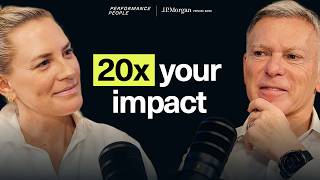
The Pareto tail refers to the statistical power law where a tiny fraction of inputs generates the vast majority of outcomes. While we are taught that life follows a normal bell curve, our careers are shaped by a few major tail events. To multiply impact, you must focus on actions that push you into that tail.
Traditional insurance prices risk based on historical data. Our shared-value model uses incentives to change customer behavior. If we help customers exercise and eat healthier, they live longer and make fewer claims. This makes our business more profitable, allowing us to share those financial savings back with them.
I had an epiphany in the bath that we could dramatically improve health outcomes by making expensive gym memberships free for our policyholders. We designed a points-based reward system where customers earned their free membership by exercising, which laid the foundation for our global Vitality platform.
When we launched Vitality in the United Kingdom, we introduced Stanley, a little dachshund, as the lazy antagonist who complained whenever his owner wanted to exercise. Over ten years, Stanley evolved in our ads to become a protagonist who champions a healthy lifestyle and personifies disciplined optimism.
If you break down a typical lifespan, seventy-five percent of your logarithmic time is spent on education, twenty percent is spent on your working career, and five percent is spent in retirement. Business leaders must realize they only have a brief twenty percent window of their life to make a real impact.
Stating a goal publicly evokes prospect theory and loss aversion. Humans are twice as motivated to avoid a loss as they are to achieve a gain. By declaring a goal, you create a potential reputation loss if you fail, which triggers a powerful psychological drive that undeclared goals cannot replicate.
Research shows that even top professional golfers putt more accurately when saving par than when trying to make a birdie. Saving par is about avoiding a loss, while a birdie is a potential gain. You cannot trick the human brain's natural loss aversion, which drives us to work harder to prevent loss.
AI poses non-trivial existential threats to humanity, which we must manage. However, I choose to focus on the massive positive opportunities. AI can handle the routine grunt work of research and briefings in minutes, freeing business leaders to focus their time on high-impact decisions in the Pareto tail.


Use this interview in your research, article, or academic work

Founder & Creative Director at Oner Active
In this interview, Oner Active founder Krissy Cela shares her journey from waitressing and compiling workout PDFs on a student laptop to building a bootstrapped…

Founder & Executive Chairperson at Biocon
In this interview, Biocon founder and executive chairperson Kiran Mazumdar-Shaw discusses the pioneering of India's biotechnology sector, from launching an enzyme startup to building a…

Co-Founder & CEO at Chapter
In this interview, Chapter co-founder and CEO Cobi Blumenfeld-Gantz discusses the company's rise to a $3 billion valuation in the senior health navigation market. He…

Founder & CEO at Tomorrow.bio
In this interview, Emil Kendziora discusses the future of cryopreservation, longevity science, and the pursuit of life extension. He explains why he views cryostasis as…

CEO at Oscar Health
In this interview, Oscar Health CEO Mark Bertolini explains how technology, AI, and consumer choice can reshape the health insurance industry. He discusses the future…

Co-Founder at Y Combinator
In this interview, Y Combinator co-founder Paul Graham reflects on twenty-one years of startup acceleration and forty-seven YC batches. Graham explores the nature of founder…