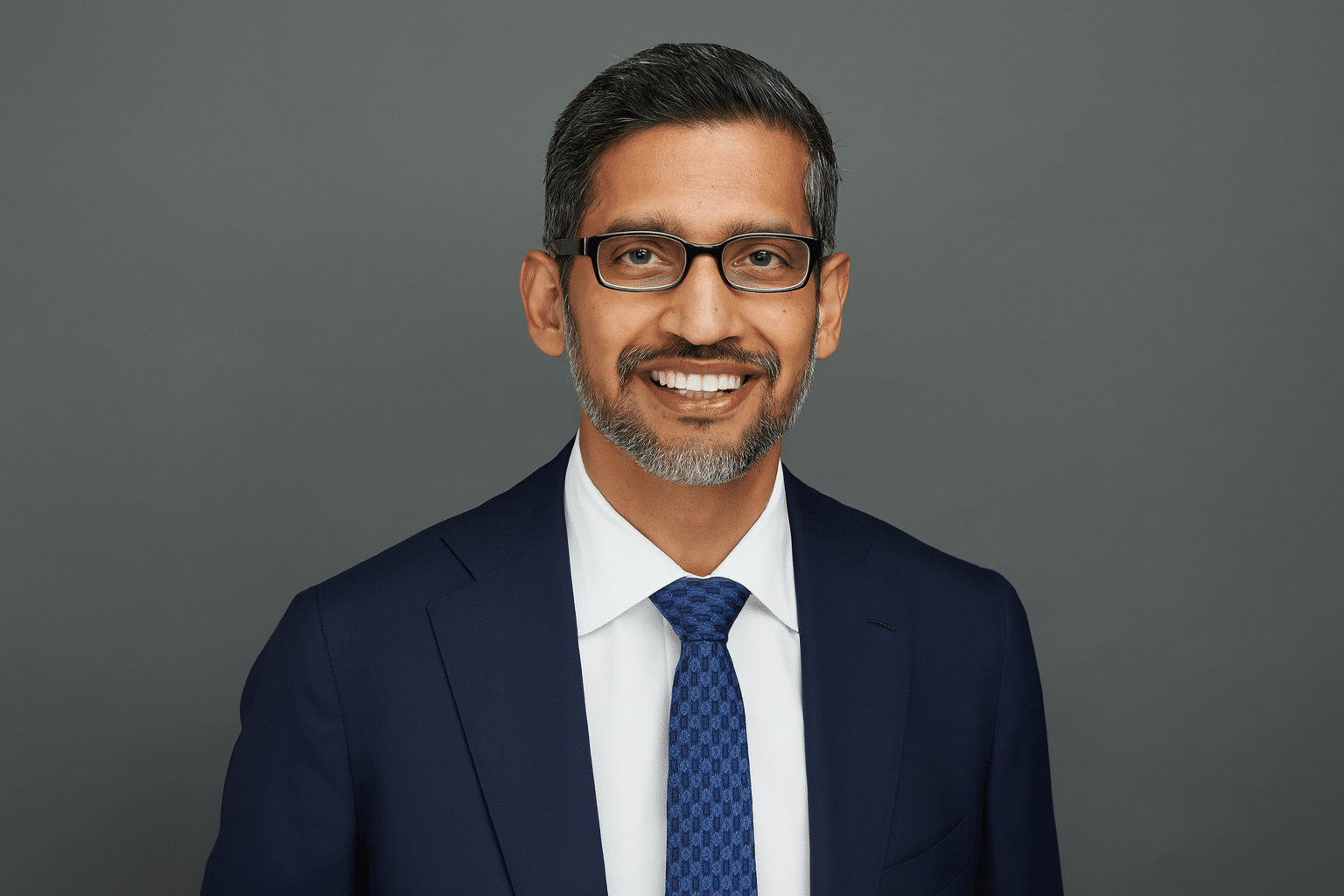
In this interview, Sundar Pichai discusses how Google is navigating a pivotal era in artificial intelligence through large-scale investment, infrastructure expansion, and long-term innovation. He shares his perspective on balancing technological progress with safety, energy demands, and societal responsibility. Pichai also offers leadership lessons on adaptability, resilience, and emotional courage, emphasizing the qualities individuals and organizations need to succeed during periods of rapid technological change.
Sundar Pichai is the CEO of Google and its parent company, Alphabet, where he oversees one of the world’s largest technology organizations. Since joining Google in 2004, he has played a key role in the development of products used by billions of people worldwide. As CEO, he leads the company’s efforts in artificial intelligence, cloud computing, and global technology innovation while focusing on responsible long-term growth.
December 12, 2025
This is interview 1 of 2 with Sundar Pichai.
Sundar Pichai has been featured on CEO Insider 2 times. Explore the full collection.
It is an extraordinary moment even by Silicon Valley standards. About every decade you get an inflection point. We had the personal computer, then the internet in the late ’90s, then mobile, then cloud. Now it is clearly the era of AI. You can feel that excitement across campuses and across the whole region.
One way to see the scale is to look at capital spending for AI infrastructure. Four years ago Google spent under 30 billion dollars per year. This year it will be over 90 billion. If you add up what all the major companies are doing, it is well over a trillion dollars going into building for this AI moment.
I see two sides. On one side, model capabilities are improving fast, people are using them, and we see real demand. We are even constrained in serving that demand. So the excitement is rational. At the same time, in every investment cycle industries overshoot. The internet had excess investment too, yet nobody questions its long-term impact now.
No company is immune from over-investment, including us. If we overinvest, we will have to work through that phase. What helps is our full-stack, long-term approach. From the underlying physical infrastructure and research to Search, YouTube, Android and our other products, we can spread the investments and focus on value that compounds across the whole ecosystem.
When I became CEO, one of the first things I did was to make Google an “AI-first” company. For us that means a full-stack approach. We invest from custom infrastructure and chips all the way to the research that pushes AI forward, and then into products and platforms. Doing all those parts together is how we build durable advantage.
Right now people can ask questions and have intelligent exchanges. In the next twelve months you will see AI doing more complex tasks. Things like buying a birthday gift, helping evaluate an investment, or explaining treatment options. These agentic experiences can support decisions and workflows, saving time and making people more effective in their personal and professional lives.
I think about it like earlier household technologies. When my family got our first refrigerator, it changed my mom’s life. It automated some tasks but freed her to do other things. Today a radiologist faces more scans and more images every year. AI can help them cope with that demand. It is about support and augmentation, not just replacement.
I would not change the basic advice. A wide variety of disciplines will still matter. What I would add is: embrace the technology and learn to use it in your field. Teachers, doctors, lawyers, creators will still be needed, but the people who do best will be those who adapt and work well with AI as part of their toolkit.
We work hard to ground models in real-world information, including using Google Search as a tool inside Gemini. But these systems predict the next token, so they are prone to errors. People should use them with that in mind. They are great for creativity and exploration. For high-stakes facts, you should cross-check and not blindly trust every answer.
Truth matters. Journalism matters. Human experts matter. If you only had stand-alone AI systems, information could become less reliable. That is why the overall information ecosystem must be richer than just AI. Search, trusted sources, teachers, doctors and institutions all stay important. Our responsibility is to build AI that fits into and strengthens that ecosystem, not replaces it.
I do not see it as a pure trade-off. The energy demand from AI is very large, so we are investing heavily in new sources: fusion, small modular nuclear, geothermal, solar and battery technology. The pressure from AI buildout is actually accelerating innovation and capital going into cleaner, more abundant energy, which can support both growth and climate goals.
We still have our 2030 goals and publish progress. It is true that faster-than-expected AI growth makes the path harder. Our answer is to meet the moment by pushing new energy technologies and smarter infrastructure. It is about scaling both digital systems and green energy together instead of slowing one to protect the other, even if the path is not linear.
This is an extraordinary moment for economies and for national security. As one of the leading AI companies, we feel a deep responsibility to engage constructively. That means working with the White House, the UK government and others to align on action plans, think carefully about misuse risks, and create industry-wide frameworks that make the technology broadly beneficial.
If you look at many of the fundamental breakthroughs in technology, immigrants are heavily represented. At Google we have had Nobel prizes and key contributions from immigrants. I came to the United States on an H-1B visa myself. I think governments understand this value and are trying to fix shortcomings so companies can keep attracting and retaining global talent.
There is real tension. The technology is moving fast and users expect us to use AI to answer more complex questions on their phones. We must move quickly to meet that demand. At the same time, we have increased investment in AI safety and security, including tools to detect AI-generated content. We try to grow boldness and responsibility in parallel.
I agree with the concern in principle. No single company should own a technology as powerful as AI. But if you look at the ecosystem today, there are many frontier models, strong open-source efforts and serious work in multiple countries, including China. We are very far from a world where everyone depends on only one AI provider for everything.
We often take progress for granted. We used to talk a lot about the Turing test and now we have gone past it. In San Francisco there are driverless cars on the road. I recently sat my eighty-year-old father in a Waymo car and saw his sense of wonder. Moments like that remind me humans can adapt and benefit from change.

Use this interview in your research, article, or academic work
Tech Lead, Product Engineering at Anthropic
In this interview, Anthropic co-founder Benjamin Mann discusses the rapid advancement of artificial intelligence, the race toward superintelligence, and why AI safety must remain a…

Co-Founder at Y Combinator
In this interview, Y Combinator co-founder Paul Graham reflects on twenty-one years of startup acceleration and forty-seven YC batches. Graham explores the nature of founder…

Founder & CEO at Food for Education
In this interview, Food for Education founder and CEO Wawira Njiru reflects on her foundational upbringing, family values, and the journey of building Africa's largest…

President & CEO at Sasol
In this interview, Sasol president and CEO Simon Baloyi discusses the operational turnaround of the global integrated chemicals and energy company. Baloyi details cross-functional collaboration…

Founder & CEO at Liquid
In this interview, Liquid founder and CEO Franklin Wang discusses the integration of conversational AI with cryptocurrency perpetual futures trading. Wang details how the Co-Invest…
Co-Founder, Chairman & CIO at Marshall Wace
In this interview, Marshall Wace co-founder and chairman Sir Paul Marshall discusses running a ninety billion USD alternative asset management firm. Marshall explains the synergy…