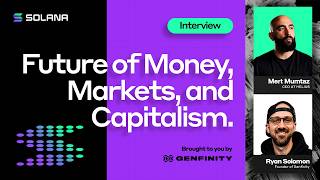
In this interview, Helius CEO Mert Mumtaz discusses the company's developer tooling infrastructure on the Solana network and their recent acquisition of Light Protocol. Mumtaz explains how zero-knowledge compression enables onchain financial privacy, outlines why AI is most valuable for smart contract security auditing, and details how internet-native money markets can modernize global capital systems to evolve the future of capitalism.
Mert Mumtaz is the co-founder and CEO of Helius, the leading developer platform and RPC infrastructure provider for the Solana network. Before founding Helius in 2022, Mumtaz worked as a software engineer at Coinbase. He is a prominent voice in the cryptocurrency community, hosting the Lightspeed podcast and advocating for onchain finance, scalability, security, and cryptographic privacy to modernize global capital markets.
August 13, 2026
Helius provides the essential developer tooling, RPC connection services, and data platform capabilities for the Solana network. Our goal is to make it as simple, fast, cost-effective, and scalable as possible for builders, creators, and entrepreneurs to build and deploy their decentralized applications and ideas on chain.
While working at Coinbase, I was frustrated that most crypto activity was just circular money movement without actual, useful applications. At the time, blockchains did not scale well and building on chain was incredibly difficult because the necessary developer tools and core infrastructure platforms simply did not exist yet.
Almost every industry has modernized through digitization over the past few decades, from communications and transportation to entertainment. However, finance remains fragmented and stuck on legacy tech. This is highly inefficient because financial coordination is what prices commodities, resources, and services across all human endeavors.
Capitalism is one of humanity's greatest inventions, but it has flaws and requires trust in human institutions. Cryptographic and game-theoretical assumptions can replace or strengthen these institutional trust frameworks. By building an open, composable, and internet-native foundation, we can make global capitalism significantly more robust, accessible, and fast.
Wealth is not just money. It is the set of physical transformations that you can cause in the world using knowledge. This is similar to how science progresses through conjectures and error correction, or how biology evolves through genes adapting to their environment. Capitalism scales these experiments globally to solve human problems.
Many projects launch AI tokens simply for speculation. While AI is highly transformative, it has no obvious natural integration with crypto today. Many decentralized compute ideas ignore real-world market dynamics, and payment rails for AI agents can easily be built with standard web APIs like Stripe.
Decentralization is not a goal in itself; it is a mechanism to lower counterparty risk. Instead of trusting a centralized bank that could freeze your account due to political pressure, you trust an immutable, decentralized network. If a process does not benefit from reducing counterparty risk, decentralizing it is unnecessary.
When a consumer web app has a bug, the developers can push a quick fix with minimal impact. But on a blockchain protocol securing billions of dollars, a single bug can cause catastrophic financial loss instantly. Crypto code must be written and tested to the extreme standards of pacemakers or space flight software.
AI tools can quickly scan and exploit open-source code, making cyberattacks more sophisticated. However, developers can also use AI to mathematically verify smart contract circuits. This accelerates the formal verification process, helping teams establish bank-grade security guarantees for their decentralized protocols.
Institutions expect standard banking-level privacy, where the bank and the client know the details, but other users cannot see them. Public ledgers expose entire transaction histories globally. If an address is accidentally de-anonymized, their entire financial record becomes public, which exposes businesses to corporate espionage.
Solana Rings is a smart contract program that provides customizable privacy on chain. It allows institutions to hide the recipient, sender, tokens, or balances based on their regulatory needs. It also supports security controls like withdrawal limits and co-signing without requiring a separate network layer.
We are launching a permissionless privacy ring that allows anyone on Solana to encrypt their balances and tokens. This enables private trading, borrowing, and lending. Because balances are fully encrypted, users are protected from front-running and MEV exploits, which are legal prerequisites for trading securities.
Solana was losing institutional projects to zero-knowledge rollups and separate privacy chains. By building on Solana using Light Protocol's zero-knowledge compression, we can encrypt data fully on chain. This preserves composability with all existing Solana liquidity and user wallets while maintaining scalability.
Prediction markets compile global knowledge to set accurate prices and forecast events. During the American election, platforms like Polymarket were on the front page everywhere. As these tools expand from sports betting to pre-IPO price discovery and commodities, they will showcase the real power of on-chain information markets.
People point out that Bitcoin has been around for over a decade. However, programmable blockchains that can actually handle high transaction volume without breaking have only existed for about two years. Solana only recently resolved its core bottleneck issues to enable stable, high-throughput applications.
Solana recently doubled its block space from forty-eight million to one hundred million compute units, allowing much more economic activity per block. Additionally, block times are being reduced from four hundred to two hundred milliseconds, which represents a massive, highly underrated engineering milestone.

Use this interview in your research, article, or academic work

Founder & CEO at Liquid
In this interview, Liquid founder and CEO Franklin Wang discusses the integration of conversational AI with cryptocurrency perpetual futures trading. Wang details how the Co-Invest…
Founder & CEO at Liquid
In this interview, Liquid founder and CEO Franklin Wang discusses the integration of conversational AI with cryptocurrency perpetual futures trading. Wang details how the Co-Invest…

Co-Founder at Fomo
In this interview, Fomo co-founder Se Yong Park discusses the rise of their social cryptocurrency trading platform and their focus on retail onboarding. Park explains…

Founder & Chairman at MicroStrategy
In this interview, MicroStrategy co-founder and Chairman Michael Saylor discusses the utility of Bitcoin as a digital capital store of value. Saylor explains why fiat…

Founder & CEO at Abra
In this interview, Abra founder and CEO Bill Barhydt shares a macro perspective on the cryptocurrency market cycle, contrasting price volatility with exponential technology growth.…
Co-founder & CEO at Coinbase
In this interview, Coinbase co-founder and CEO Brian Armstrong joins Nikhil Kamath to explore the evolution of global finance, stablecoin economics, and cryptocurrency opportunities in…